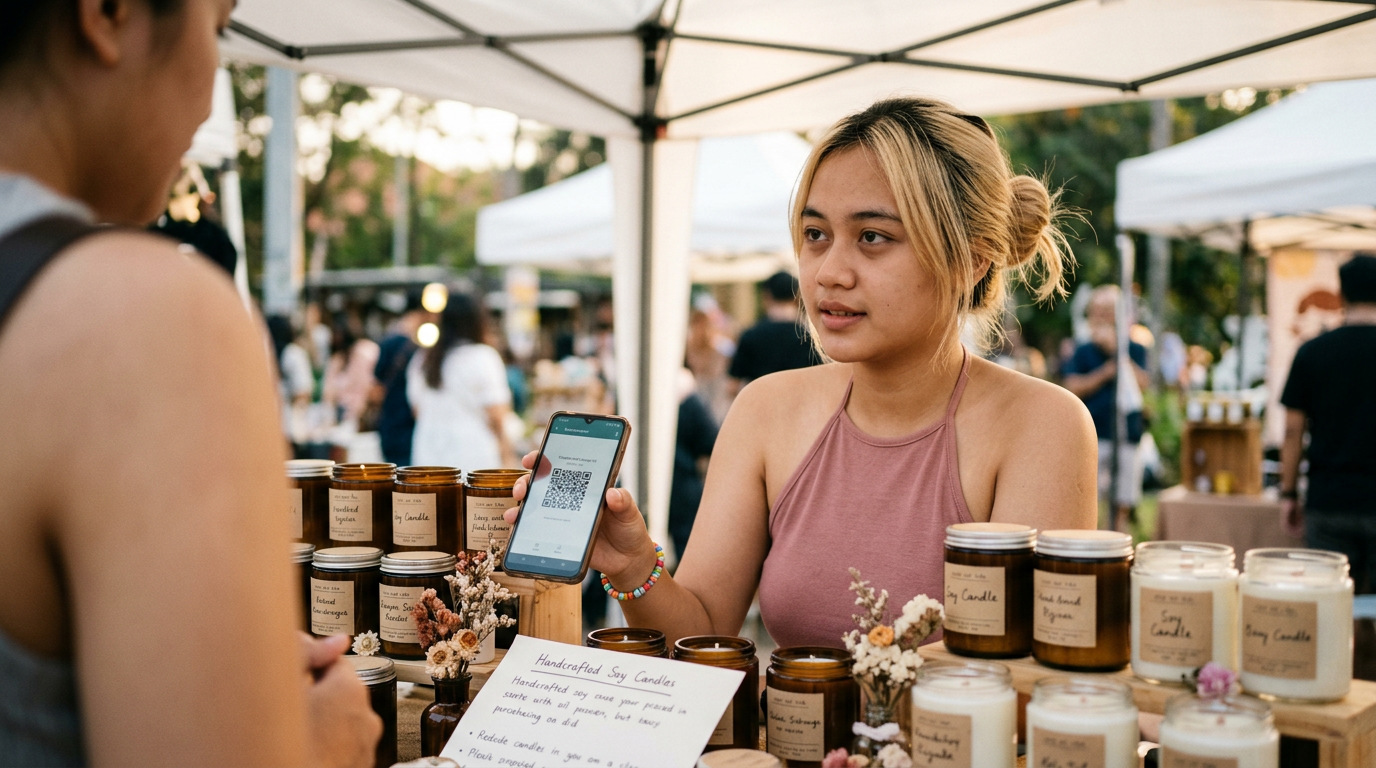
If you sell at a market stall or pop-up, a PayNow QR code is usually all you need. Every Singapore banking app can scan it, and the money lands in your account in seconds.
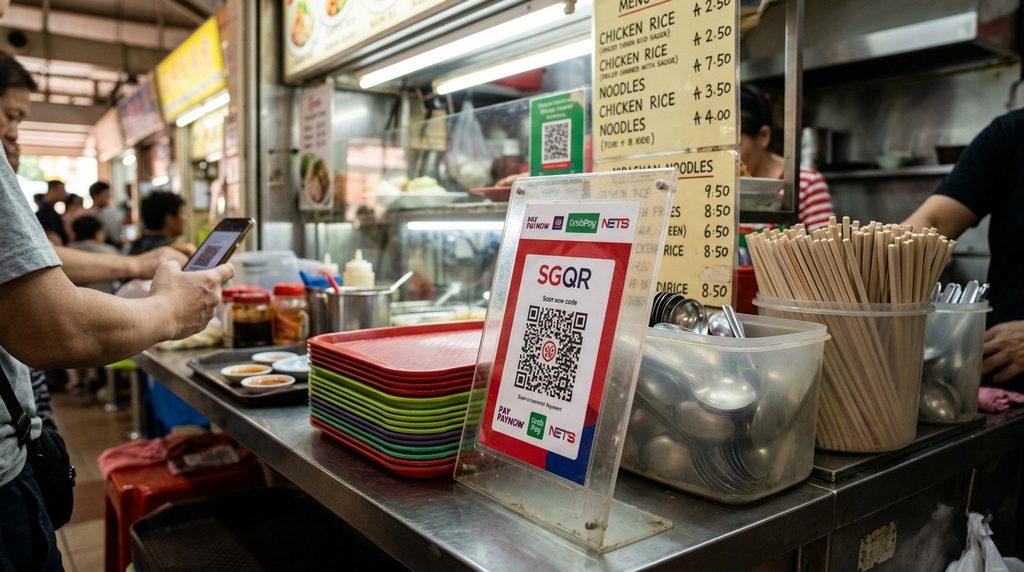
But then a customer asks, “can pay by NETS or not?” And you notice the drinks stall next to you has one QR sticker on the counter that takes PayNow, NETS and a handful of e-wallets.
That sticker is an SGQR label. It combines several QR payment options into one code, and PayNow is one of them. We explained the difference between SGQR and PayNow, and why online stores don’t need SGQR, in What is SGQR PayNow. This post is for sellers who take payments in person and want the sticker.
Who Gives You an SGQR Code?
Not MAS. MAS and IMDA run the SGQR scheme, but the MAS merchant page says that to accept SGQR payments, you need individual contractual arrangements with the merchant acquirers. A merchant acquirer is the bank or payment company that lets you accept a particular payment method.
MAS lists 30 of them, including DBS, OCBC, UOB, NETS, Maybank, Standard Chartered, FavePay, ShopBack and FOMO Pay. Your acquirer is also who you contact if a payment goes wrong or you suspect fraud.
So for most small sellers, the easiest place to start is your own bank. You already have PayNow there, and PayNow is the scheme most of your customers will use.
What You Need Before You Apply
A bank SGQR label is built on PayNow Corporate, which is PayNow registered to your business’s UEN rather than your mobile number. UOB’s SGQR form, for example, asks for your PayNow proxy as “UEN+Suffix”, and DBS says you must have PayNow registered with DBS before you apply.
So you need three things:
- A UEN, from registering your business with ACRA.
- A business current account in your business’s name.
- PayNow Corporate linked to that account.
If you’re a sole proprietor and don’t have these yet, we walked through all three, with costs, in how to register a UEN for PayNow.
How to Apply for SGQR at OCBC, UOB and DBS
Each bank has its own process. Here is what each one asks for.
OCBC: In the OCBC Business app, go to Settings, then Manage PayNow & SGQR, and select Create New Label. In OCBC Velocity, it’s under Tools, then Manage PayNow & SGQR. Online registration is immediate. If you’re on a package without online access, you can use the paper form, which takes up to 5 business days. OCBC then mails the label within 10 working days.
UOB: Fill in the SGQR registration form. It asks for:
- Name on label: Up to 25 characters, including spaces. This is the name your customers see.
- Payment reference (optional): Also up to 25 characters. It shows on your business statement, and the customer can’t change it.
- Outlet address: The postal code is compulsory. If you have more than one counter or stall, each gets its own entry.
- Number of labels: UOB mails 4 labels to the address the bank has on file. You can ask for more in sets of 4.
DBS: If you use DBS IDEAL, log in and register your PayNow proxy for SGQR there. If not, download the form from the same page. DBS sends complimentary printed labels and recommends displaying only one label at each counter.
DBS’s SME pricing guide lists its business accounts for Singapore-incorporated businesses, so if you’re a sole proprietor, ask DBS first whether you’re eligible.
Adding NETS, GrabPay and Other Wallets
A label from your bank starts with PayNow. Every other payment method on the sticker needs its own agreement with an acquirer that offers it. Once you have that, it goes onto the same SGQR label, and the logos on the label show which payment methods you accept.
Each acquirer sets its own fees for this. MAS and IMDA do not get involved in commercial matters between merchants and acquirers, so there is no standard rate to compare against. Ask each one for its fee per transaction before you sign.
What It Costs
For PayNow only, very little.
- The labels: Typically given free by your bank after successful registration.
- Receiving PayNow: UOB and OCBC both list a S$0.20 fee per incoming PayNow Corporate payment, waived until 31 December 2028 (UOB, OCBC).
- The business account: This is the real cost, at about S$35 to S$120 a year in account fees, plus a minimum balance. The full breakdown is here.
For other payment methods, the cost is whatever each acquirer charges.
Do You Actually Need SGQR?
An SGQR label is a static code. The customer scans it and then types in the amount themselves. That’s fine at a drinks stall where everything costs S$2.50. But at a market stall selling S$38 candles and S$12 wax melts, a mistyped amount means you’re chasing the difference.
But if you want to be able to input the price into your QR code so that customers don’t need to type anything, then you can generate one using our Android app. So the customer just scans and confirms.
Whichever you use, MAS gives the same advice: check for a notification that the payment is successful before you hand over the goods. A screenshot on the customer’s phone is not a payment. We covered how to spot a fake one in is PayNow safe.
If your PayNow is ready and you want to start taking payments today, download our Android app and make your first QR with the amount already filled in.